Recast Calculators

Mortgage Recast Calculator

See your new monthly payment after a lump-sum principal payment, with the recast fee counted, a break-even month, and a side-by-side look at recasting vs refinancing vs extra payments. Free, instant, and private: no signup, no email, no limits, and nothing leaves your browser.

Recast calculator

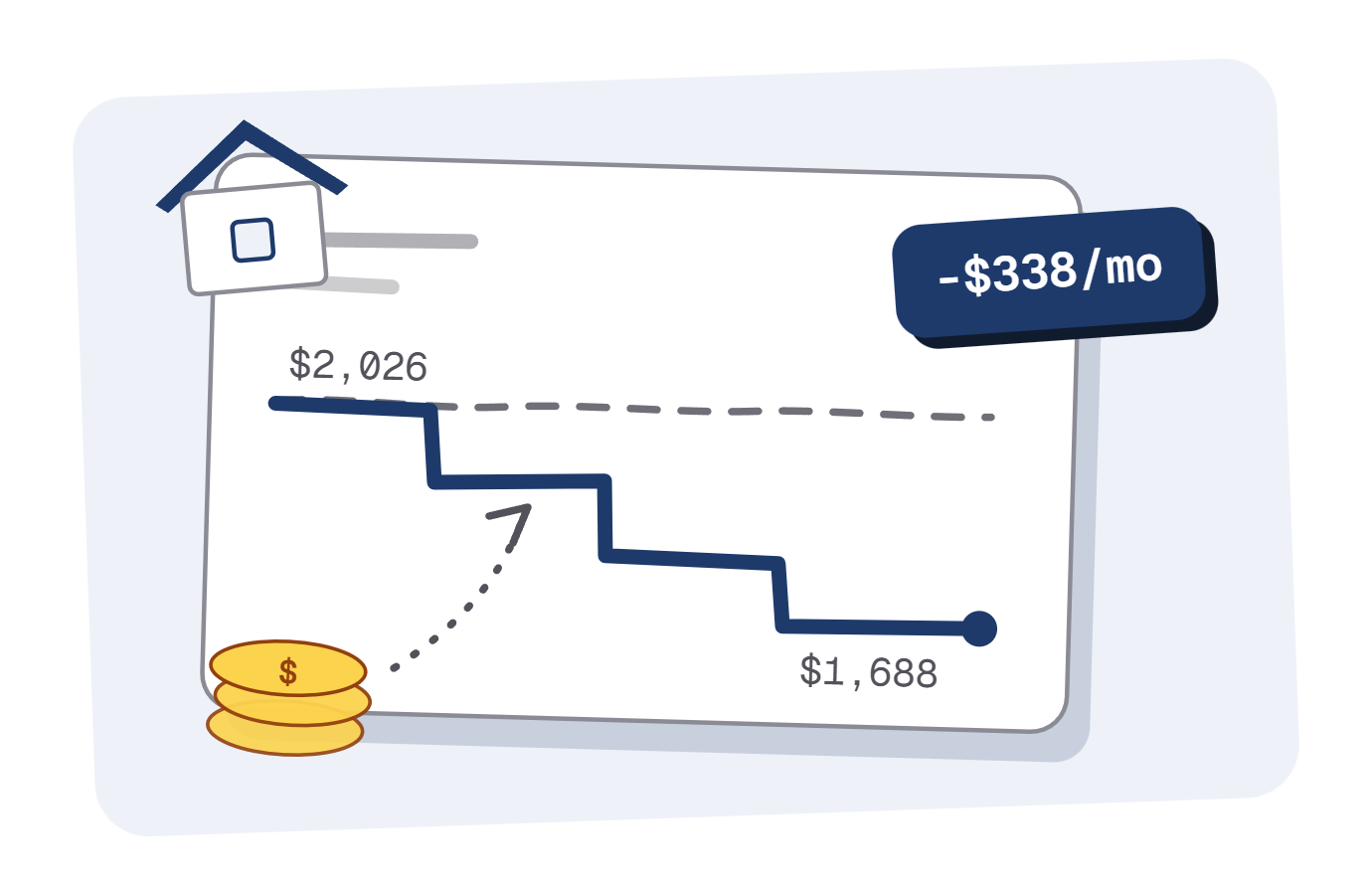
Mortgage recast illustration: a lump-sum principal payment drops the monthly payment from $2,026 to $1,688, saving $338 per month while the rate and payoff date stay the same
How a mortgage recast works: the lump sum lowers the balance, the payment steps down, and the payoff date never moves. Figures from the worked example below.

About this free mortgage recast calculator

This is a free mortgage recast calculator built to answer one question precisely: what happens to your monthly payment if you put a lump sum toward your principal and ask your servicer to re-amortize the loan? Enter your balance, rate, remaining term, current payment, and lump sum, and the tool runs entirely online in your browser, updating as you type. There is no signup, no email gate, and no usage limit. If you are hunting for the best mortgage recast calculator for your situation, judge any tool on three things: the math must keep your rate and term fixed (a recast is not a refinance), it must subtract the recast fee from your savings, and you must be able to verify the method. Those three checks are exactly what this calculator was built around.

With amortization schedules and extra payments

Most tools stop at the new payment. This is a mortgage recast calculator with amortization built in: it produces the complete before-and-after schedule, year by year or payment by payment, so you can see how much of every dollar goes to interest versus principal. It also works as a mortgage recast calculator with extra payments. The "lump sum only" scenario models paying principal down without recasting, and the keep-paying toggle shows what happens if you recast and then keep sending your old payment anyway, which shortens the payoff while keeping a lower required floor. General-purpose amortization calculators on portals like Bankrate can chart a loan, but they are not built to compare recasting against refinancing and extra principal side by side, and in our testing of page-one tools, none subtracted the recast fee from the savings figure. This one does, and shows the month the fee pays for itself.

The formula, with a worked example

The mortgage recast calculator formula is the standard amortization equation: M = P x [r(1+r)^n] / [(1+r)^n - 1], where P is your balance after the lump sum, r is your monthly rate, and n is the months remaining. The rate and the term never change; only the principal does. A quick mortgage recast calculator example: $300,000 at 6.5% with 25 years left costs about $2,026 a month. Apply a $50,000 lump sum and the same formula on $250,000 gives $1,688, keeping roughly $338 every month. Every figure here is computed in exact integer cents and checked against 66 automated tests; the full method, including how rounding is handled, is documented on our methodology page. If you would rather build a mortgage recast calculator in Excel yourself, the formula above drops straight into Excel's PMT function, and the free Excel export gives you the same numbers without building anything.

Chase, Rocket Mortgage, Wells Fargo, Bank of America, and other servicers

Recast math is identical everywhere, so this works as a Chase mortgage recast calculator, a Rocket Mortgage recast calculator, or a Wells Fargo or Bank of America mortgage recast calculator, and just as well for Mr. Cooper, Truist, Newrez, or a smaller servicer like Movement Mortgage. What differs by lender is policy, not arithmetic: the servicer dropdown auto-fills the documented fee and minimum for ten major lenders from their own published pages, links to our verified fee table, and warns you when your lump sum is below your lender's documented minimum.

Escrow, taxes, and insurance

Enter principal and interest only. A recast changes the P&I portion of your bill; escrow for taxes and insurance is set separately by your servicer and continues on top of whatever new payment you see here. That is why there is no escrow field: a home mortgage recast calculator with escrow bundled in would only blur the one number a recast can actually change. Add your current escrow amount to the result to estimate your full bill.

Last updated · Reviewed against Fannie Mae and Freddie Mac servicing guides and official lender policies.

What a mortgage recast actually does

A recast, formally a re-amortization, has one job: it lowers your required monthly payment without touching anything else. You send your servicer a large principal payment (a "principal curtailment"), pay a small processing fee, and sign a short agreement. The servicer then recalculates your payment by spreading the new, smaller balance over the months you already had left, at the rate you already had.

Three things never change in a recast: your interest rate, your payoff date, and your loan itself. There is no new loan, no credit check, no appraisal, and no underwriting. That is the entire difference from a refinance, which replaces your loan with a new one at today's rates and costs 2% to 6% of the balance in closing costs. The mechanics are set out in Fannie Mae Servicing Guide C-1.2-01, which also requires that a recast not be reported as a loan modification.

A worked example at 2026 rates

Say you owe $300,000 at 6.5% with 25 years remaining, paying about $2,026 a month in principal and interest. You inherit $50,000 and apply it as a recast with a $250 fee:

  • New payment: about $1,688, so you keep roughly $338 every month.
  • Interest saved: about $51,000 over the remaining life of the loan, after the fee.
  • Break-even: the $250 fee is recovered by the payment savings in the first month.
  • Payoff date: unchanged. You still finish in 25 years, just cheaper each month.

Now compare the same $50,000 used differently. Left as extra principal without a recast, your payment stays $2,026 and the loan ends about 8 years early, saving the most interest overall. Used to refinance into a new 30-year loan, your payment could fall further, but you would restart the clock, pay thousands in closing costs, and give up your rate. The calculator above runs all four scenarios on your real numbers.

Who can recast, and who cannot

Recasting is a servicer-level option for conventional loans backed by Fannie Mae or Freddie Mac, and for many jumbo and portfolio loans at the lender's discretion. Government-backed programs are the big exception: FHA, VA, and USDA loans generally cannot be recast, because their servicing rules have no voluntary re-amortization path. Servicers also expect the loan to be current, often with several months of on-time payment history, and most set a minimum lump sum of $5,000 to $10,000.

Policies differ more than most articles admit. Chase states no fee and no minimum (while noting fees may apply), while Truist wants 10% of your balance plus $250. We keep a lender-by-lender table of verified fees and minimums, each figure sourced from the servicer's own published documents.

How to request a recast

  1. Call your servicer and ask whether your loan qualifies for a recast, and confirm the minimum, the fee, and the process.
  2. Send the lump sum, clearly designated as a principal-only payment, plus any required request form. Some servicers, like Mr. Cooper, want the form before the money.
  3. Sign the re-amortization agreement your servicer sends back, and keep paying your normal payment until the new amount takes effect, usually within 30 to 60 days.

Our step-by-step recasting guide covers the full process, including a sample request letter you can adapt.

When a recast is the right move

A recast shines when you have a lump sum, you like your current rate, and monthly cash flow matters: after selling a previous home, receiving an inheritance or bonus, or heading into retirement on a fixed income. It is the cheapest payment cut in the mortgage world. It is the wrong tool when your rate is far above today's market (consider a refinance), when your priority is finishing the loan early (extra principal payments win), or when the lump sum would drain the cash cushion you may need later; unlike money in savings, principal paid into a house is hard to get back out. Our guide to whether recasting is worth it walks through the trade-offs.

Frequently Asked Questions

What is a mortgage recast calculator?

A mortgage recast calculator shows what your monthly payment becomes after a lump-sum principal payment, when your servicer re-amortizes the smaller balance over the same remaining term at the same rate. It is different from a refinance calculator, which models a new loan at a new rate. This one also subtracts the recast fee, computes the break-even month, and compares recasting against refinancing, extra principal payments, and doing nothing.

How does this mortgage recast calculator work?

Enter your current balance, interest rate, remaining term, monthly principal-and-interest payment, lump sum, and recast fee. The calculator re-amortizes the reduced balance with the standard formula M = P x [r(1+r)^n] / [(1+r)^n - 1] and updates as you type: new payment, monthly savings, interest saved after the fee, break-even month, a four-scenario comparison, and full before-and-after amortization schedules.

Does the calculator include escrow, taxes, and insurance?

No, and that is deliberate. A recast changes only the principal-and-interest portion of your bill. Escrow for property taxes and homeowners insurance is set separately by your servicer and continues on top of the new payment. Enter your P&I only; then add your current escrow amount to the result to estimate your full monthly bill.

Can I download the results to Excel?

Yes, free. You can export the full before-and-after amortization schedule as an Excel workbook (a summary sheet plus a payment-by-payment sheet) or as a CSV, print a clean PDF report, or copy a share link that restores every input. No signup or email is required for any export.

Does it work for Chase, Rocket Mortgage, Wells Fargo, or Bank of America loans?

Yes. Recast math is the same at every servicer, so the calculator works for Chase, Rocket Mortgage, Wells Fargo, Bank of America, Mr. Cooper, U.S. Bank, PNC, Truist, Newrez, LoanDepot, and smaller servicers such as Movement Mortgage. The servicer dropdown auto-fills the documented fee and minimum for ten major lenders from their own published pages, and warns you if your lump sum is below your lender’s documented minimum.

What is a mortgage recast?

A mortgage recast (also called re-amortization) is when you make a large lump-sum payment toward your principal and your servicer recalculates your monthly payment based on the new, lower balance. Your interest rate and payoff date stay exactly the same; only the required monthly payment drops. Fannie Mae covers the process in Servicing Guide section C-1.2-01.

How much can a recast lower my monthly payment?

The reduction is roughly proportional to the principal you pay down. If your lump sum cuts the balance by 20%, your payment drops by about 20%. For example, on a $300,000 balance at 6.5% with 25 years left, a $50,000 lump sum lowers the payment from about $2,026 to about $1,688, keeping roughly $338 every month.

What is the minimum lump sum needed to recast?

Most servicers require $5,000 to $10,000 in principal reduction, though policies vary widely. Chase states no minimum, Bank of America requires $5,000 within six months, and Truist requires 10% of your unpaid balance. Check our lender-by-lender table or call your servicer.

How much does a mortgage recast cost?

Typically $150 to $500, and often around $250. Wells Fargo and Bank of America state no recast fee, and Chase states none while noting that fees may apply. Either way it is far cheaper than refinancing, which usually costs 2% to 6% of the loan amount in closing costs.

Does recasting change my interest rate or payoff date?

No. A recast keeps your original interest rate and your original payoff date. Only the required monthly payment changes. If you want a different rate or term, that is a refinance, not a recast.

Which loans can be recast?

Conventional loans backed by Fannie Mae or Freddie Mac can generally be recast, and many jumbo loans can at the lender’s discretion. FHA, VA, and USDA loans generally cannot be recast; their programs do not allow voluntary re-amortization. Alternatives for those loans include extra principal payments or a streamline refinance.

Is it better to recast or refinance?

Recast when you are happy with your rate and want a lower payment cheaply, with no credit check, appraisal, or closing costs. Refinance when today’s rates are meaningfully below yours and the interest savings will outrun the closing costs. In a high-rate environment, borrowers holding older low-rate loans usually come out ahead recasting rather than giving up their rate.

Should I recast or just make extra principal payments?

Extra principal payments keep your required payment the same and shorten the loan, saving the most total interest. A recast lowers the required payment but keeps the original term. If monthly cash flow is the goal, recast. If finishing sooner is the goal, pay extra principal. Recasting and then voluntarily paying the old amount gives you both: a lower required floor plus the faster payoff while you can afford it.

How long does a mortgage recast take?

Most servicers complete a recast in 30 to 60 days after receiving the lump sum, the fee, and a signed agreement, and up to 90 days at some servicers. Mr. Cooper documents up to 90 days. Chase, Rocket Mortgage and Bank of America publish no processing time at all, so ask when you call. Keep making your normal payment until the new one takes effect.

How many times can I recast my mortgage?

There is usually no lifetime limit, but many servicers restrict frequency. Bank of America allows one recast per rolling 12-month period, and Rocket Mortgage counts principal paid within a 12-month window toward its $10,000 minimum. Each recast typically requires a new qualifying lump sum and fee.

Do I keep making payments while the recast is processed?

Yes. Continue your regular monthly payment until your servicer confirms the recast is complete and gives you the new payment amount, usually via a signed re-amortization agreement. Missing a payment during processing can cancel the request.

Does recasting require a credit check or affect my credit score?

No. A recast is not a new loan and is not a loan modification for credit purposes, so there is no credit check, no appraisal, and no direct credit-score impact. Fannie Mae explicitly instructs servicers not to classify a re-amortization as a modification.